
How Do You Redirect Your Mail in the UK?
How Do You Redirect Your Mail in the UK – When you’re moving house or relocating your business, your post is a critical piece of the puzzle. You’ve got two main routes to make sure it follows you: the official Royal Mail Redirection service or a more flexible private mail forwarding service.
Which one is right for you? It really boils down to what you need. Are you just after a simple, temporary fix for a house move, or do you need a permanent, feature-rich address for your personal or business life?
Why Bother Redirecting Your Mail? It’s Essential.
It’s easy to overlook your post in the chaos of a move, but letting it pile up at your old address is more than just an inconvenience. Forgetting to redirect your mail can mean missing much more than a few birthday cards.
Think about what comes through your letterbox: bank statements, DVLA updates, confidential letters from HMRC, and crucial business correspondence. If that sensitive information falls into the wrong hands, you’re opening the door to identity theft and fraud. For a business, a single missed invoice or legal notice could have serious financial or operational knock-on effects. It’s a simple risk to avoid with a bit of forward planning.
The Main Reasons to Get It Sorted
Setting up a mail redirection is a small bit of admin that buys you a huge amount of peace of mind. It’s your safety net during a period of change, making sure everything runs smoothly and securely.
Here’s why it should be high on your to-do list:
- Protect Your Identity: Stop sensitive documents like bank statements and credit card offers from being seen by the new occupants. A practical example would be a credit card offer arriving at your old home, which could be used by someone else to apply for credit in your name.
- Keep Your Business Running: Make sure invoices, payments, and client communications arrive without a hitch, protecting your cash flow and your professional reputation. For instance, missing a cheque from a key client could disrupt your finances for weeks.
- Stay on the Right Side of the Law: Guarantee you receive important legal notices from bodies like HMRC or Companies House, helping you hit deadlines and avoid penalties. A simple jury duty summons, if missed, can result in a fine.
- Don’t Miss the Personal Stuff: From letters from friends to your favourite magazine subscriptions, a redirection makes sure nothing gets left behind.
By taking a moment to manage your post, you create a seamless transition. This isn’t just about convenience; it’s about protecting your personal information, maintaining your professional integrity, and making sure life carries on without a hitch, no matter where you are.
Choosing the Right Mail Redirection Service for You
Figuring out how to redirect your mail is the first, crucial step. Get this right, and you’ll save yourself a lot of hassle down the line. The best choice really boils down to your situation: are you just moving house for a fixed period, or do you need a more flexible, long-term solution for your post?
Let’s break down the two main options you’ve got.
The Traditional Route: Royal Mail Redirection
Royal Mail’s redirection service is the one everyone knows. It’s the official, go-to option for anyone moving within the UK or heading abroad. For a standard house move where you know your new address and how long you’ll be there, it’s often the simplest and most direct choice. It reliably forwards your letters and most parcels that come through the Royal Mail network.
But it does have its limits. You’re locked into fixed contracts of 3, 6, or 12 months, which isn’t great if your plans are a bit up in the air. For example, if you’re in temporary accommodation while house-hunting, you might not know how long you’ll need the service for.
The biggest snag, though? It only handles mail sent via Royal Mail. Any parcels coming from other couriers like DPD, Evri, or an Amazon Logistics driver will still be delivered to your old address. If you do a lot of online shopping, this can quickly turn into a real headache.
Flexible Alternatives: Private Mail Forwarding
This is where things get interesting. Private mail forwarding, often called a virtual address, offers a totally different level of control. These services give you a unique UK address that’s yours to use for as long as you need it. The major advantage here is that they can receive mail and parcels from any courier. No exceptions.
This is a game-changer for a few different types of people:
- Frequent Movers or Digital Nomads: If you’re always on the move or don’t have a permanent base, a virtual address gives your mail a stable home, no matter where you are in the world.
- Freelancers and Business Owners: Using a private address gives your business a professional sheen without plastering your home address all over the internet. It’s a simple way to protect your privacy and look more established.
- UK Expats and International Residents: Many services offer digital mail scanning, meaning you can get an email with your post the day it arrives. No more waiting weeks for important letters to be shipped overseas.
To help you see which path makes sense, this quick flowchart lays out the main things to think about.
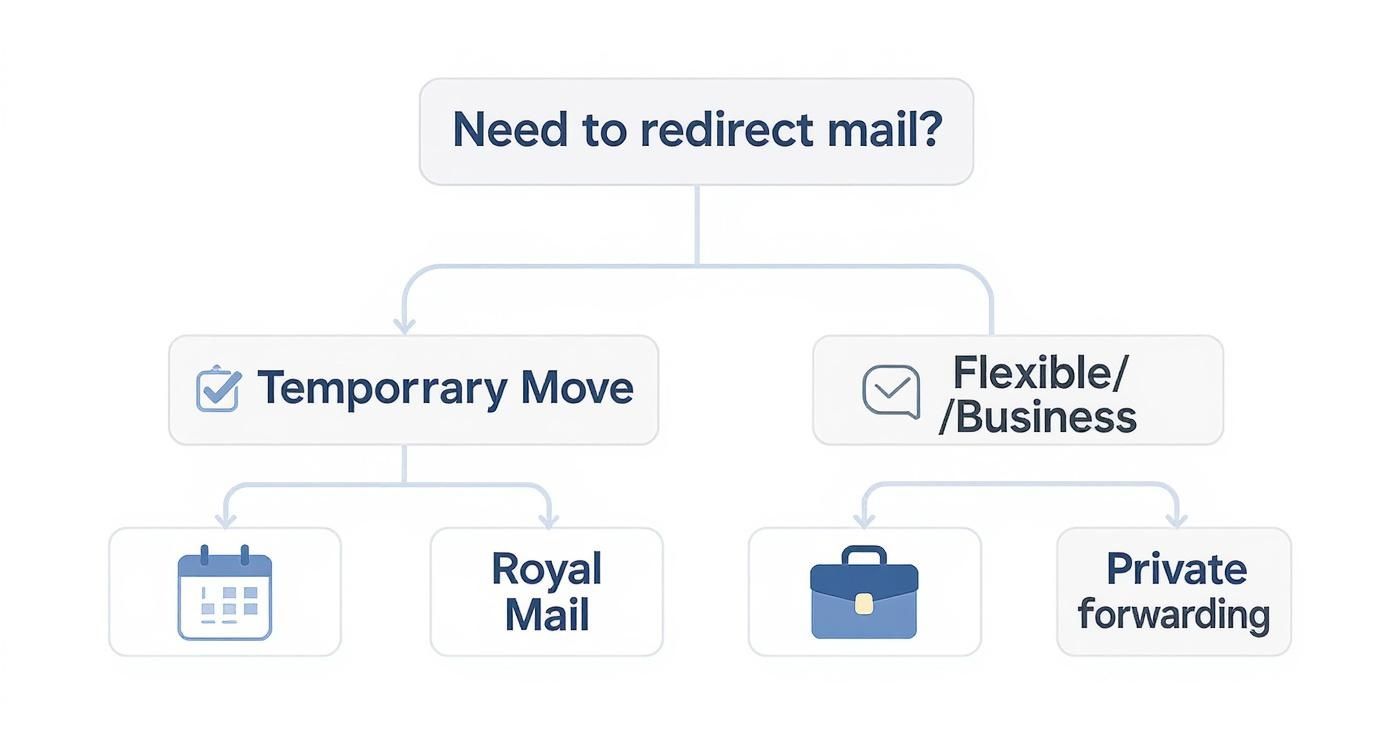
Royal Mail Redirection vs Private Mail Forwarding at a Glance
Sometimes, seeing the options side-by-side is the easiest way to decide. This table breaks down the key differences to help you figure out which service is the right fit for your needs.
| Feature | Royal Mail Redirection | Private Mail Forwarding / Virtual Address |
|---|---|---|
| Courier Acceptance | Only Royal Mail items | All couriers (Royal Mail, DPD, Evri, etc.) |
| Contract Length | Fixed terms (3, 6, 12 months) | Flexible (monthly, yearly, pay-as-you-go) |
| Address Type | Forwards from your old address | Provides a new, permanent address |
| Digital Scanning | Not available | Often a core feature (read mail online) |
| Best For | Simple, short-term house moves | Businesses, expats, frequent movers, privacy |
| Privacy | Links old and new addresses | Keeps your residential address private |
Ultimately, Royal Mail is often fine for a straightforward, personal move. But if you need something more robust for your business, or your personal situation is a bit more complex, a private service offers a world of difference.
Think about this real-world scenario: A consultant is moving to Dubai for a two-year contract. She sets up a private mail forwarding service in the UK. When an urgent letter from HMRC arrives, the service scans it and emails it to her that same day. A few weeks later, her mum sends a birthday parcel via DPD. It’s received safely and held until she asks for it to be forwarded. This just wouldn’t be possible with a standard Royal Mail redirection.
Choosing the right option from the get-go means your mail system is working for you, not creating more problems. For anyone looking for true flexibility, exploring a UK mail forwarding service is the perfect way to get a solution that fits modern life.
Getting Started with Royal Mail Redirection
So, you’ve decided the traditional Royal Mail route is the one for you. Smart move. It’s a tried-and-tested service for a reason. The whole process is refreshingly straightforward, whether you’re more comfortable doing things online or popping down to your local Post Office.
You’ve got two main ways to get the ball rolling: head over to the Royal Mail website or grab an application form from any Post Office branch. Most people find the online application a bit quicker, as you can do it all from the comfort of your sofa. That said, if you’ve got questions or just prefer dealing with things in person, the Post Office option is a great alternative.
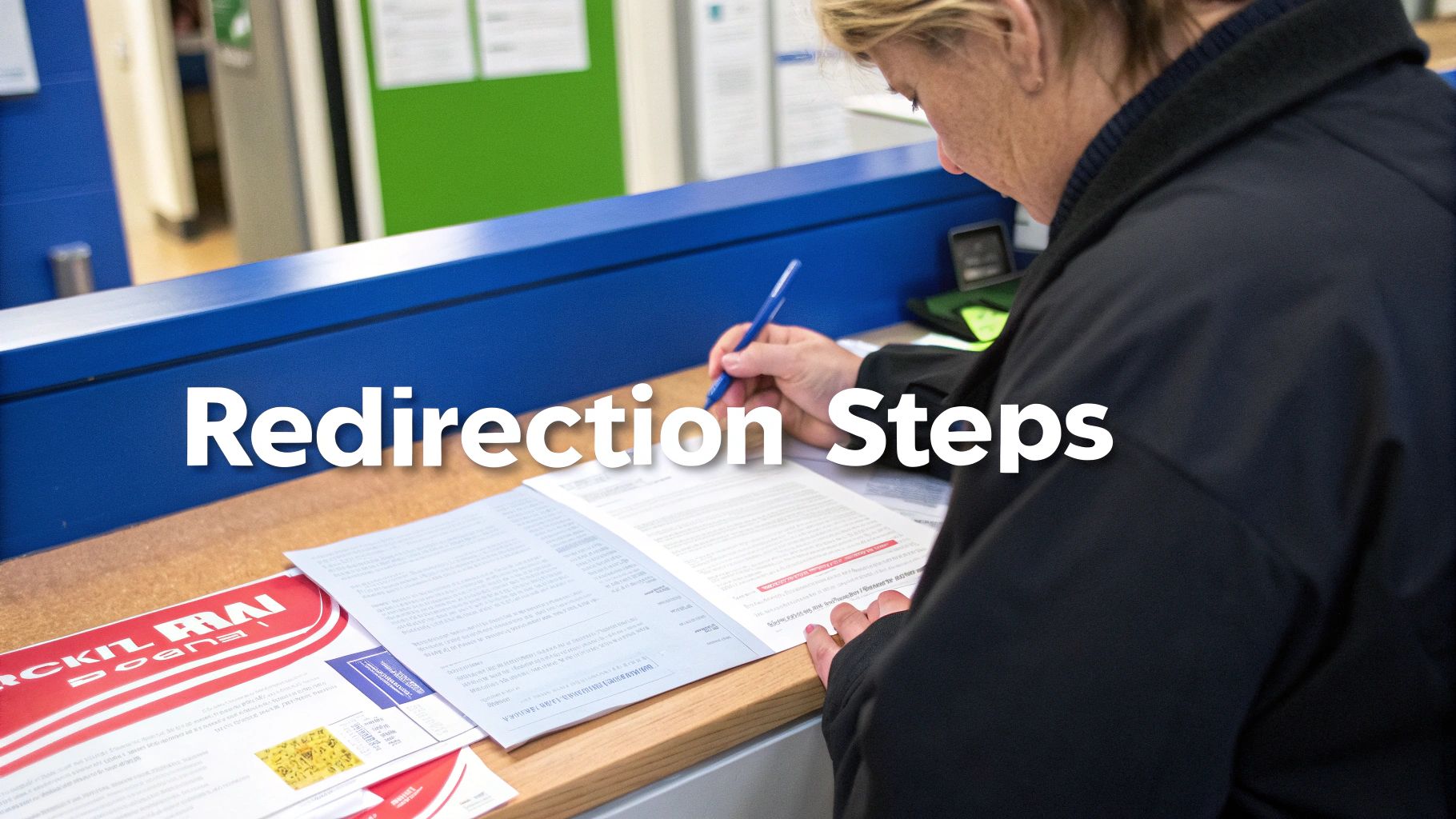
It’s a massively popular service here in the UK. In fact, Royal Mail helps over 1.2 million people redirect their mail every year. And the results speak for themselves—a huge 92% of users report their post arrived without any major hiccups. That’s a solid track record by anyone’s standards.
What You’ll Need to Hand
Before you dive in, it pays to get your documents in order. Having everything ready to go will make the application process a breeze. An actionable insight here is to create a small folder (digital or physical) with scans or copies of these documents before you start.
You’re going to need to provide:
- Proof of your old and new addresses. Think recent utility bills or bank statements for both.
- Proof of ID for yourself and any other adults moving. A valid passport or UK driving licence will do the trick.
- The full names of everyone who needs their mail redirected. This is a big one. You have to list every single person.
Here’s a common pitfall I see all the time: people forget about name variations. Does someone in your household go by their middle name for work? Or is their maiden name still linked to older accounts? You need to include all these variations. Royal Mail will only forward letters addressed to the exact names you list on the form.
Costs and Timelines to Keep in Mind
The price you pay depends on how long you need the service for, with standard options for 3, 6, or 12 months. It’s important to know that the costs are calculated per last name, not per household. So, if you live with people who have different surnames, you’ll need to set up and pay for a separate redirection for each one.
It’s also worth keeping an eye on price adjustments. We keep track of the latest updates on recent Royal Mail price increases to help you stay in the loop.
Timing is everything. Royal Mail strongly advises applying at least three weeks before you move. This gives them enough breathing room to process your application and run all the necessary checks, ensuring your mail follows you from day one without a single letter going astray. Once you’ve submitted everything, they’ll send a confirmation to let you know it’s all set up.
Advanced Mail Solutions for UK Businesses
For any UK business, post isn’t just letters and parcels; it’s a core part of your professional image and legal setup. While a standard Royal Mail redirection is perfect for a simple house move, businesses often need something far more robust and strategic. This is where virtual office addresses and dedicated mail forwarding services really come into their own.
These services offer so much more than a place for your mail to land. Think of them as a powerful tool for building credibility, protecting your privacy, and ensuring you meet your legal obligations without any compromises. It’s all about creating a polished, professional front for your company, no matter where you actually do your work.
Building Credibility from Day One
Imagine you’re launching a new tech start-up. You might be coding away in a spare room in Manchester, but you want to project the image of a serious, established player. By using a virtual office address, you can instantly have a prestigious London W1 postcode on your website, business cards, and invoices.
This simple step can make a huge difference. It builds immediate trust with potential clients, investors, and partners who often associate certain postcodes with success and stability. You get all the benefits of a prime location without the crippling overheads of physical office space, freeing up capital you can invest back into actually growing your business.
Meeting Legal Requirements and Protecting Your Privacy
For limited companies in the UK, the law demands you have both a Registered Office Address and a Director’s Service Address. A crucial point here is that these addresses are published on the public record at Companies House, making them completely visible to anyone.
Using your home address is a common misstep for new business owners. It exposes your personal residence to the world, blurring the lines between your private life and your business operations.
A virtual address acts as an essential privacy shield. By using a dedicated business address for all your official correspondence, you keep your home address off public databases. This protects you and your family from unsolicited mail, unwanted visitors, and potential security risks.
A virtual address solution solves this problem elegantly. It provides a compliant, professional address for all your official mail from Companies House and HMRC, ensuring you meet your legal duties while keeping your home life completely separate and private.
Practical Scenarios for Modern Businesses
The flexibility of these services makes them a perfect fit for all sorts of business models. Let’s look at a few real-world examples:
- The Sole Trader: A freelance graphic designer uses a virtual address to look more established than competitors working from home. It also means they don’t have to share their home address with every single client they invoice.
- The E-commerce Retailer: An online seller uses their mail forwarding service to handle customer returns. This prevents a constant stream of packages arriving at their house and provides a professional returns address that builds customer confidence.
- The Remote-First Team: A company with employees scattered across the UK uses a central virtual office to consolidate all its official mail. Important documents are scanned and emailed to the right person, keeping operations smooth without a physical headquarters.
These examples show how you can manage your mail in a way that actively supports your business goals. For a deeper dive into the specifics, our UK business post redirection guide covers everything you need to know.
Ultimately, it’s about choosing a solution that grows with you, offering both a professional image and complete peace of mind.
Common Mail Redirection Mistakes to Avoid
Even a tiny oversight can cause big headaches when you redirect your mail. A simple slip-up might lead to missed bank statements, lost parcels, or sensitive documents falling into the wrong hands. By getting ahead of these common pitfalls, you can make sure your transition is completely seamless.

One of the most frequent mistakes we see is people leaving it too late. Setting your start date too close to your moving day is a recipe for disaster. Royal Mail needs time to get your request processed, so applying at least three weeks in advance is the safest bet to avoid any frustrating gaps in your mail delivery.
Overlooking the Details on Your Application
The details you put on your application form are absolutely crucial. A common slip-up is forgetting to include every single person in the household. Royal Mail is very specific about this; it will only forward post for the exact names listed on the application.
- Forgetting Name Variations: Remember to include maiden names, middle names that are sometimes used, or even slightly different spellings that might be lurking on older accounts.
- Assuming One Application Covers All: If you live with people who have different surnames, each last name requires its own separate redirection application and its own fee.
These small details make a massive difference between a successful redirection and a pile of important mail being left behind at your old address.
It’s a classic case of “the devil is in the detail.” Forgetting your partner’s name or a maiden name means their specific mail—like a credit card statement or a letter from the DVLA—will simply not be forwarded.
Assuming Redirection Is a Catch-All Solution
Another major misstep is thinking a redirection service covers absolutely everything. While it’s an excellent safety net, it’s not a substitute for updating your address directly with important organisations. As an actionable insight, create a checklist of key contacts a month before your move.
You should still make a point of notifying key bodies yourself:
- Your bank and any other financial institutions
- HMRC and Companies House
- The Driver and Vehicle Licensing Agency (DVLA)
- Your local council for council tax
- Subscription services and your favourite online retailers
What’s more, a standard Royal Mail redirection will not forward parcels delivered by other couriers like DPD or Evri. These will still be sent to your old address, which is a huge limitation for anyone who shops online regularly.
Despite these potential pitfalls, mail redirection services are highly effective when set up correctly. In fact, one survey found that 84% of consumers reported receiving all their important mail successfully. Understanding the limitations is the key to making the service work for you. You can find more insights on customer satisfaction in the latest network report.
Got Questions About Redirecting Your Mail?
Even with a plan in place, a few lingering questions often pop up when you’re arranging a mail redirection. Getting these sorted will give you the confidence that everything is set up perfectly, with no nasty surprises down the line.
Let’s run through some of the most common queries we hear.
How Quickly Does a Mail Redirection Actually Start?
Timing is everything, especially when you’re moving. With a standard Royal Mail redirection, you’ll need to allow a minimum of 5 working days after they’ve approved your application and verified your ID. To be safe, I always recommend getting your application in at least two or three weeks before you need it to go live.
On the other hand, private mail forwarding services are usually much quicker off the mark. Because they manage mail at their own secure address rather than trying to intercept it from your old one, many can have your new address up and running within 24 hours.
Can I Get My Mail Redirected to an International Address?
Yes, absolutely. Both Royal Mail and private companies have solid options for forwarding your post overseas.
- Royal Mail: They offer specific international redirection packages, with different prices for Europe and the rest of the world. It’s a dependable choice for letters and standard post.
- Private Services: This is where things get really useful for international moves. Many offer fantastic extras like parcel consolidation, where they’ll bundle several packages into one big shipment. This can save you a small fortune on postage costs.
The right service really depends on the type and amount of mail you’re expecting while you’re abroad.
For anyone living overseas, a service with digital scanning is a total game-changer. Imagine getting an urgent letter from your bank scanned and emailed to you the day it arrives in the UK, instead of waiting weeks for it to cross the globe.
What Happens if I Forget to Add Someone’s Name to the Application?
This is an easy mistake to make, and unfortunately, it can be a costly one. Royal Mail is incredibly strict about this: they will only redirect post that is addressed to the exact names listed on the application.
If a name is missed, any mail for that person will either be delivered to your old address (which you likely won’t have access to) or, more likely, just returned to the sender.
It’s crucial to list everyone in the household, including any variations you use. Think maiden names, middle names, or professional titles. While you might be able to amend an application by calling Royal Mail, it’s not guaranteed and could involve extra fees or even starting over.
Will Parcels Be Redirected Along with My Letters?
This is a big one, and the answer completely depends on the service you’ve chosen and, importantly, which courier is delivering the parcel.
If you go with a Royal Mail redirection, most items sent via the Royal Mail network will be forwarded, including their own Tracked 24/48 parcels. But here’s the major catch: parcels sent by any other courier—like DPD, Evri, or Amazon Logistics—will not be redirected. They will still be dropped off at your old address.
This is probably the single biggest reason people choose a private mail forwarding service instead. A private address provider can accept deliveries from any courier, without exception. This ensures you never miss a package, no matter who sent it, making it a far more reliable solution if you do a lot of online shopping.
Ready to take control of your mail with a solution that fits your life? Acorn Business Solutions offers flexible, secure, and professional mail forwarding and virtual address services to keep your personal and business correspondence organised, no matter where you are. Explore our mail forwarding and virtual address options.
Related Topics

Professional Indemnity Insurance
Discover what is professional indemnity insurance, why your business needs it, and how it shields you from costly client claims.

What is a company secretary
Moving home? Learn how do you redirect your mail with Royal Mail or private services. A practical guide to costs, setup,

Top accounting courses for small business in the UK (2025)
Discover accounting courses for small business in the UK. Compare top options, pricing, and formats

UK Business Bank Accounts With No credit Checks
Discover UK business bank accounts with no credit checks. This guide explains your options and eligibility
Managing cash flow for small business: Quick tips
Discover managing cash flow for small business with practical steps to forecast, optimize liquidity,

Your Guide to the company unique tax reference number
Discover what the company unique tax reference number is, why you need it, and how to locate yours quickly.