
Companies House Certificate of Good Standing
Companies House Certificate of Good Standing – A Companies House certificate of good standing is, quite simply, official proof that a UK limited company is playing by the rules. Think of it as a clean bill of health for your business, verifying its uninterrupted existence since the day it was formed and confirming that no action is being taken to strike it from the register. It’s an absolutely essential document for building trust with banks, investors, and international partners.
What a Certificate of Good Standing Really Means

While it might seem like just another piece of administrative paperwork, a Companies House certificate of good standing carries far more weight. The best way to understand its importance is to think of it as a business passport. Just as your personal passport verifies your identity and right to travel, this certificate validates your company’s legal identity and its right to operate without any black marks against its name.
It’s an official declaration from the UK’s registrar of companies that your business is meeting its core legal duties. This isn’t just a one-time document; it’s a real-time snapshot of your company’s compliance health at a specific moment in time.
The Core Pillars of Good Standing
So, what exactly does this “passport” confirm to anyone who asks to see it? It provides undeniable proof of several critical compliance points.
This table breaks down the key information confirmed by the certificate and what it means in practice.
Certificate of Good Standing at a Glance
| Information Included | What It Confirms |
|---|---|
| Company Details | Confirms the company’s full name and registered number. |
| Director Details | Lists the names of the current company directors. |
| Secretary Details | Lists the names of any current company secretaries. |
| Registered Office | Confirms the official address of the registered office. |
| Statement of Good Standing | States the company has been in continuous, uninterrupted existence and no action is being taken to strike it from the register. |
When you present this certificate, you are showing that your company:
- Has an Unbroken History: It confirms your company has been in continuous, uninterrupted existence since the day it was incorporated.
- Is Up-to-Date with Filings: All mandatory documents, such as annual accounts and confirmation statements, have been submitted to Companies House on time.
- Is Not Facing Dissolution: There are no active proposals or pending actions to have your company struck off the official register.
In short, it’s Companies House giving your business a solid stamp of approval.
Why This Official Stamp of Approval Matters
The certificate’s real value lies in its ability to build immediate trust and credibility. For instance, when a potential investor is doing their homework on your business, this document provides independent verification that your company is managed correctly. It removes doubt and signals that the business is stable and legally sound.
Similarly, when expanding overseas, foreign authorities often require it to register a local branch, treating it as definitive proof that your UK entity is legitimate. Understanding its role is crucial in financial compliance, a complex area where specialised AI agents for finance compliance can offer deeper insights. The certificate is fundamentally tied to your company’s unique registration number, a detail that often confuses new business owners. If you’re unsure, you can learn more about https://www.acornbusinesssolutions.com/what-is-the-crn-number/ in our detailed guide.
Ultimately, a Certificate of Good Standing transforms your company’s compliance status from a simple internal metric into a powerful external asset. It is the official, government-backed evidence that your business is reliable, well-maintained, and ready for its next major opportunity.
Key Scenarios Where You Will Need a Certificate of Good Standing
It’s one thing to know what a Companies House certificate of good standing is, but it’s another to know when you’ll actually need one. This isn’t just a piece of bureaucratic paper; it’s a vital tool that can open doors for your business. Think of it as your company’s official seal of approval in a variety of high-stakes situations.
Let’s move from theory to practice and look at the real-world scenarios where this certificate becomes absolutely essential. Having one ready to go can be the difference between seizing a golden opportunity and getting stuck in frustrating delays.
Securing Finance and Investment
When you’re applying for a business loan or chasing investment, you can bet that lenders and venture capitalists will be doing their homework. They need solid proof that your company is a safe bet, and a certificate of good standing is a cornerstone of that due diligence process.
For a bank or lender, it’s a quick, official check that confirms your company is compliant and not about to be struck off the register. This simple fact dramatically reduces their risk and shows them you run a tight ship. Potential investors will almost always ask for one early on, using it as a baseline check before they even think about committing capital.
A clean certificate tells a powerful story to financial backers: this is a business that takes its legal obligations seriously, has its house in order, and is built on a solid legal foundation.
Opening Business Bank Accounts
Trying to open a business bank account, especially with some of the newer digital-first or international banks, often requires more than just your incorporation documents. These banks have incredibly strict “Know Your Business” (KYB) checks in place to combat fraud and money laundering.
A Companies House certificate of good standing is the official, instant verification they need of your company’s current legal status.
- For UK Banks: It provides an extra layer of assurance, which is particularly helpful for newer companies that don’t have a long trading history to fall back on. For example, a fintech bank might request it to speed up an application for a company incorporated less than a year ago.
- For International Banks: It’s often a non-negotiable requirement. A UK company trying to open an account in the USA will find that an apostilled certificate is a standard part of the application pack, proving the UK entity is legitimate and fully compliant in its home country.
Without this certificate, you could easily find your application gets bogged down in delays or is flat-out rejected, throwing a major spanner in the works of managing your company’s finances.
Expanding Your Business Overseas
Taking your business international is a huge step, but it comes with a mountain of paperwork. Whether you want to register a branch, set up a subsidiary, or just start trading in a new country, the authorities there will need to verify that your UK company is the real deal.
This is where the certificate is indispensable. Foreign governments and registration bodies won’t just take your word for it; they demand official documentation from your company’s home registry. The certificate of good standing serves as that definitive proof, confirming your business is legally sound and has an unbroken existence back in the UK. For example, if you plan to set up an office in Dubai, the local authorities will require an apostilled certificate as a core part of the business registration process.
Winning High-Value Contracts and Tenders
When you’re bidding for big corporate contracts or public sector tenders, your company’s credibility is put under the microscope. The procurement processes are famously strict, and proving you are fully compliant is often a basic entry requirement.
Submitting a certificate of good standing with your bid can give you a real competitive edge. It gives the other party instant confidence that your business is stable, reliable, and operating within UK law. This is particularly crucial for government contracts, where demonstrating legal and financial integrity is everything. Having this document ready to go shows foresight and professionalism, signalling that you’re a serious contender ready for a serious partnership.
How to Get Your Certificate from Companies House
Getting your hands on a Companies House certificate of good standing is a pretty straightforward affair, but there’s one massive catch: your company has to be completely up-to-date with its legal filings. Before you even think about applying, it’s absolutely vital to make sure all your business’s legal obligations are met.
Think of it like getting a mortgage. You wouldn’t rock up to the bank with a messy credit history and expect them to approve your application. In the same way, Companies House won’t issue a certificate confirming your company’s good health if its records are in a state.
The First Step: A Quick Compliance Check
Before you place an order, take a moment to give your company’s filing status a quick health check. This one simple action can save you from the single most common reason an application gets delayed or flat-out rejected.
You need to be certain that:
- All your annual accounts are filed: Double-check you haven’t slipped up on any deadlines for submitting your company’s financial accounts.
- Your confirmation statement is current: This is the yearly filing that confirms all the information Companies House holds on your business is correct. An overdue statement is a classic showstopper. You can get the full picture on managing this in our detailed guide to the Companies House confirmation statement.
- There’s no strike-off action pending: Your company can’t be in the process of being dissolved or struck off the register.
This quick check is the best insurance policy you can have for a smooth, hassle-free application.
The Ordering Process Explained
Once you’ve confirmed your company has a clean bill of health, you’re ready to order. The process itself is designed to be simple, just asking for basic information you’ll have to hand.
You’ll need to provide your full registered company name and your company registration number (CRN). Companies House uses these two key details to find your business and verify its standing on the official register.
Ordering a Certificate of Good Standing is less about filling out complicated forms and more about demonstrating your company’s ongoing commitment to its legal duties. A clean filing history is the real application.
Next, you just need to pick the service speed that works for you. Companies House usually offers a couple of options:
- Standard Service: This is the most popular, cost-effective choice. The physical certificate is typically sent out within four working days.
- Express Service: If you’re in a rush, there’s often an expedited service available for an extra fee, which cuts down the dispatch time significantly.
This flowchart shows just how crucial this certificate can be at major business milestones, from securing finance to building investor confidence.
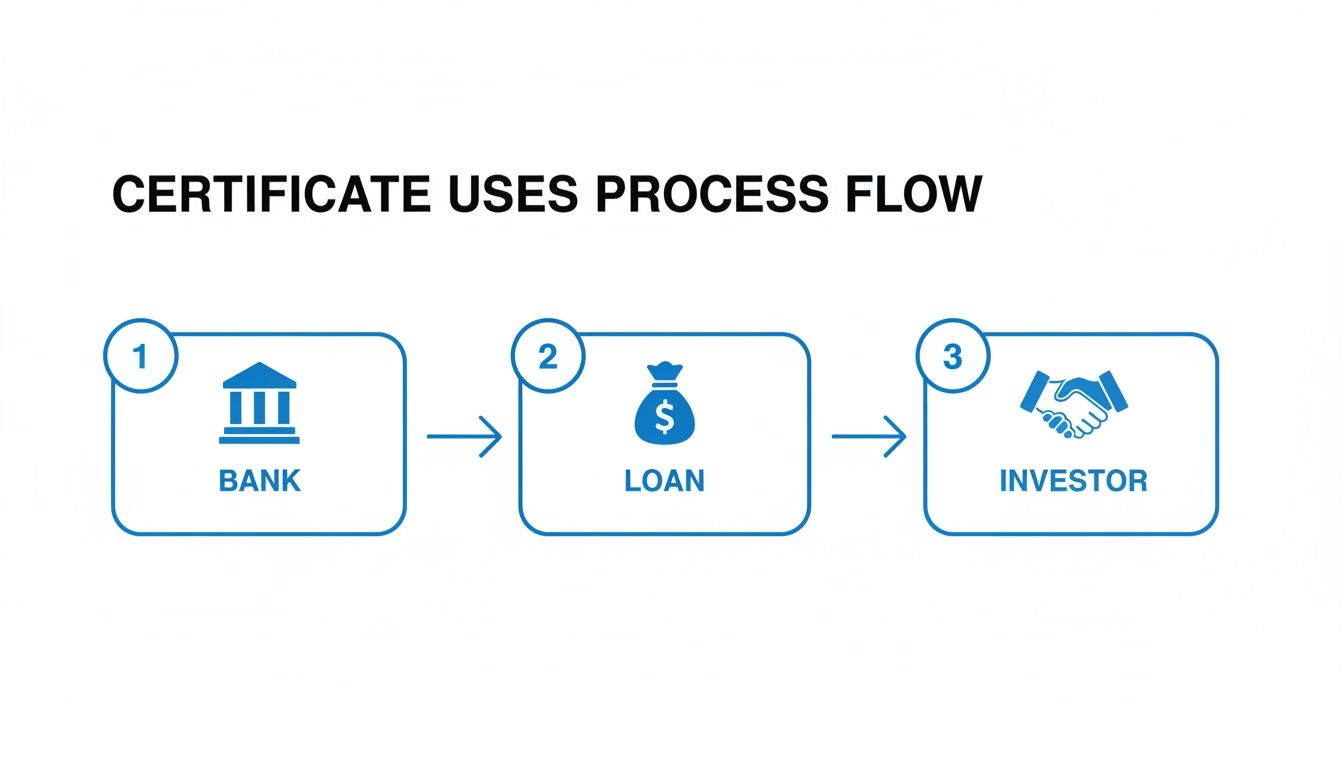
The journey from the bank to a loan and finally to an investor shows how this one document underpins a company’s credibility every step of the way.
Choosing the Right Format and Delivery
The final step is deciding on the format for your certificate. Your choice will usually depend on who’s asking for it and why.
- Physical Paper Certificate: This is the standard, official document printed on Companies House watermarked paper and popped in the post. It’s almost always what’s needed for official purposes like opening an overseas branch, legal proceedings, or formal bank applications where only an original, physical document will do.
- Digital (PDF) Copy: A digital version can often be supplied much faster, sometimes even the same day if you go for an express service. While it’s incredibly convenient, it’s vital you check if a digital copy is actually acceptable. Many institutions, particularly those overseas, will insist on seeing the original paper certificate.
A bit of planning goes a long way. Think about the deadlines you’re working to and factor in the delivery times. If the certificate is for international use, don’t forget to allow extra time if it also needs to be legalised with an apostille—a separate process that happens after you receive it. By checking your compliance first and picking the right service, you can get your certificate without any last-minute drama.
Decoding the Information on Your Certificate
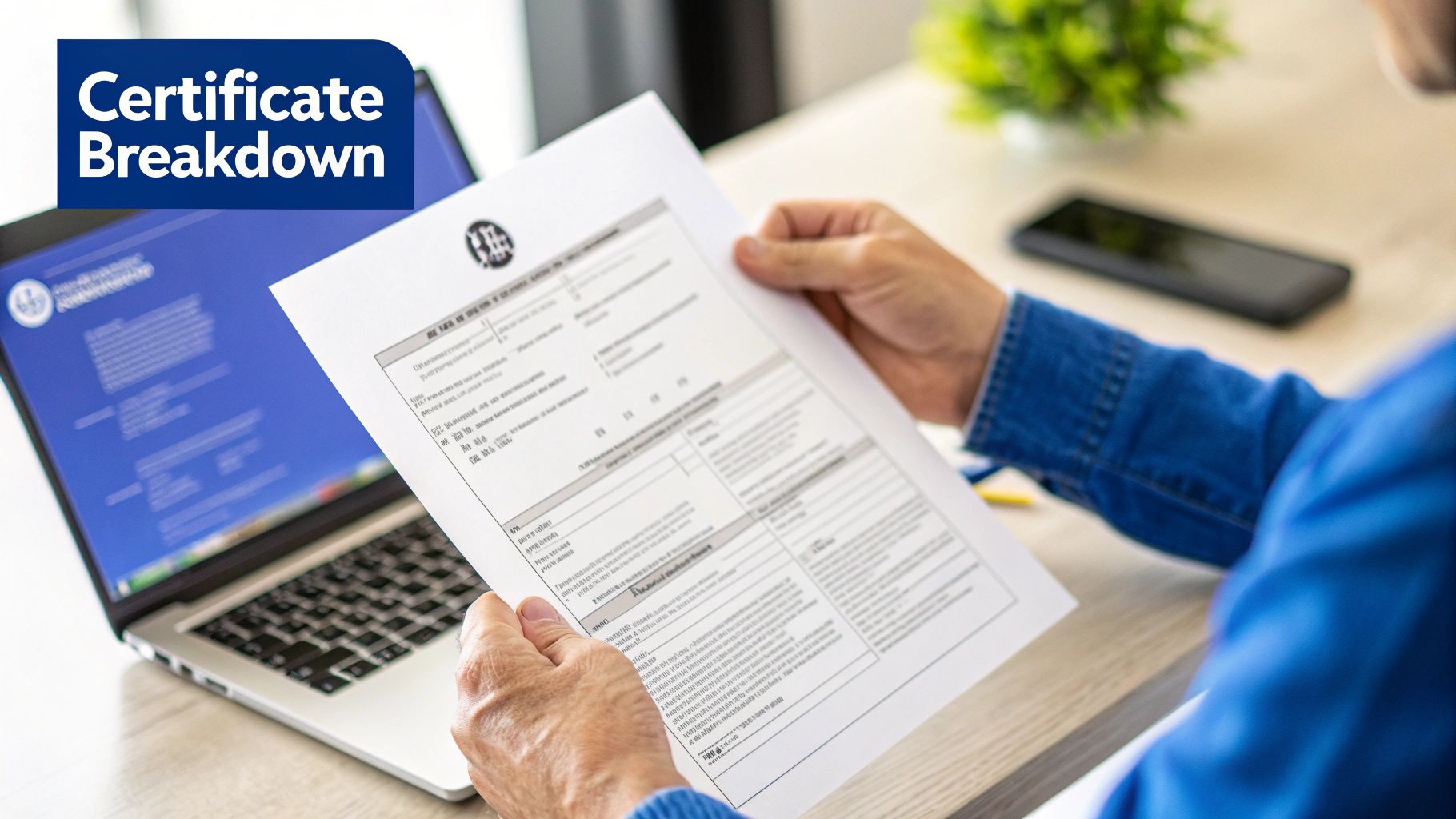
When your Companies House certificate of good standing finally lands on your desk, it might seem like a fairly straightforward document. But don’t be fooled by its simplicity—every detail printed on that watermarked paper has a job to do, painting a clear picture of your company’s legal health. Knowing what you’re looking at is the key to using it properly.
At its heart, the certificate is a validation tool. It gives a third party—like a bank or a potential investor—a snapshot of your company’s official status, starting with the absolute basics. These core facts are non-negotiable and form the bedrock of the document’s authority.
Standard Information on Every Certificate
Every single certificate, no matter what extras you add on, comes with a standard set of details. This is the essential data that makes the document valid and confirms your company’s identity and legal standing.
You can always expect to see:
- Company Name and Registration Number: The two key identifiers for your business on the official UK register.
- Date of Incorporation: This shows exactly when your company was legally formed, establishing its age and history.
- The Statement of Good Standing: This is the most important bit. It’s a formal declaration from Companies House confirming that the company has been in continuous existence and isn’t about to be struck off the register.
This statement is what gives the certificate its real power. It’s the official government seal of approval that people rely on.
“I can confirm that, according to the records on the register, [Your Company Name] has been in continuous, unbroken existence since its incorporation and that no action is currently being taken to strike the company off the register.”
That sentence, as simple as it looks, carries immense weight. It’s the reassurance a bank, investor, or foreign authority is looking for, confirming your company is compliant in one authoritative statement.
Optional Information You Can Request
Beyond the standard details, you can ask Companies House to bolt on extra information. This is where you can tailor the certificate to meet very specific needs, which is often crucial for more complex deals or setting up operations abroad. Getting this wrong can lead to rejection, meaning you have to order a new certificate and face frustrating delays.
You can ask to include things like:
- Registered Office Address: Essential for verifying your company’s official legal address in the UK.
- Company Directors’ Names: Often a requirement from banks as part of their Know Your Business (KYB) checks.
- Company Secretary’s Name: Necessary if your company has a secretary and their details need to be officially verified.
- Share Capital Information: Details the company’s statement of capital, which can be vital for due diligence during mergers or acquisitions.
Practical Examples for Optional Details
Choosing the right optional information isn’t just ticking boxes; it’s a practical decision. For example, say you’re opening a business bank account in Germany. The bank might have a strict policy that requires director names to be explicitly listed on the certificate so they can cross-reference them with your application.
Likewise, a potential partner looking at a joint venture might want to see your share capital information on the certificate to get a clear picture of your company structure before they commit. The actionable insight here is to always ask the requesting party precisely what information they need on the certificate before you order it. A quick email can save you time and money.
Common Reasons an Application Might Be Rejected
Having your application for a Companies House certificate of good standing rejected can feel like a sudden, frustrating roadblock, especially when an urgent business deal is on the line. But this rejection is never random. It’s a clear signal that your company isn’t meeting its core legal duties, and Companies House simply can’t vouch for its health until those issues are sorted.
Think of it like an MOT for your car. The garage can’t give you a pass certificate if the brakes are dodgy or the tyres are bald. In the same way, Companies House won’t issue a certificate of good standing if your company’s paperwork is incomplete or late. The good news is, most of the common reasons for rejection are easy to spot and, more importantly, quick to fix.
Overdue Annual Accounts or Confirmation Statements
This is, by a huge margin, the most common reason an application gets turned down. Companies House runs on a very strict schedule for company filings. If your annual accounts or confirmation statement are even a single day late, your company is no longer considered to be in ‘good standing’.
The system is automated and unforgiving; there’s no grace period here. An overdue filing instantly flags your company as non-compliant, making it ineligible for the certificate until the missing document is filed and officially accepted.
- The Problem: Your annual accounts or confirmation statement have sailed past their filing deadline.
- The Fix: This one is straightforward. You have to file the overdue document immediately. The fastest route is using the Companies House online service, which processes submissions much quicker than posting them. Once the document is accepted, your company’s status will be updated, and you can apply for the certificate again.
An Active Proposal to Strike the Company Off
A much more serious problem is finding a “proposal to strike off” notice against your company. This is a formal process kicked off by Companies House, usually after repeated failures to file documents or if they have reason to believe the company has stopped trading. It’s the final warning before your company is dissolved and removed from the register for good.
While this notice is active, your company is definitively not in good standing. Even trying to request a certificate at this stage is impossible, as the business is already on a path to being wiped from existence.
- The Problem: There is a live gazette notice for compulsory strike-off against your company.
- The Fix: You must act fast to stop the strike-off process. This means immediately filing all overdue documents and paying any outstanding fines. You may also need to formally object to the strike-off to pause the action, giving you the time needed to get your company’s records completely up to date.
Issues with Company Officers
Under UK company law, every private limited company must have at least one director who is a “natural person”—in other words, a human being, not another company. While it’s possible to have corporate directors in some setups, that legal minimum of one human director must always be met.
If your company’s directorships change and you dip below this legal requirement, Companies House cannot certify that you are compliant with the Companies Act 2006.
A company without the legally required number of directors is fundamentally non-compliant. This isn’t just a minor administrative slip-up; it’s a breach of a core legal rule that automatically blocks a certificate of good standing from being issued.
- The Problem: The company does not have at least one natural person appointed as a director.
- The Fix: You need to appoint a new director who is a natural person as soon as you can. This appointment must be formally registered with Companies House. Once it’s officially recorded on the public register, your company will meet the minimum legal standard, clearing the way for a successful certificate application.
Understanding Certificate Validity And International Use
It’s a common mistake to think of a Companies House certificate of good standing as a permanent, unchanging document. The reality is quite different. You need to see it as a ‘snapshot in time’—it proves your company was compliant on the exact day it was issued, and not a moment later.
This has some very real practical consequences. A company’s status can change overnight. One missed filing deadline the day after your certificate is printed, and it’s already out of date. Because of this, most official bodies and institutions treat the document as having a very short shelf life.
How Long Is A Certificate Valid For?
You won’t find an official expiry date printed on the certificate itself, but there’s a clear industry standard: three months. That’s the accepted window of relevance.
Banks, foreign government agencies, and potential business partners will almost always reject a certificate older than this. Why? Because after three months, it no longer gives them reliable assurance that your company is still meeting its obligations.
Timing, therefore, is everything. To avoid the frustration of having your certificate turned down for being stale, you should only order it when you’re close to needing it. This ensures the information is fresh and reflects your company’s live compliance record at Companies House.
A Certificate of Good Standing is perishable. Think of it like a newspaper—it’s only valuable when it’s current. Presenting an old certificate is like showing yesterday’s news to prove today’s facts.
Using Your Certificate For International Business
For any UK company with ambitions to expand overseas, the certificate of good standing is absolutely essential. It’s your official introduction, proving to foreign governments and banks that your business is legitimate and properly maintained in its home country.
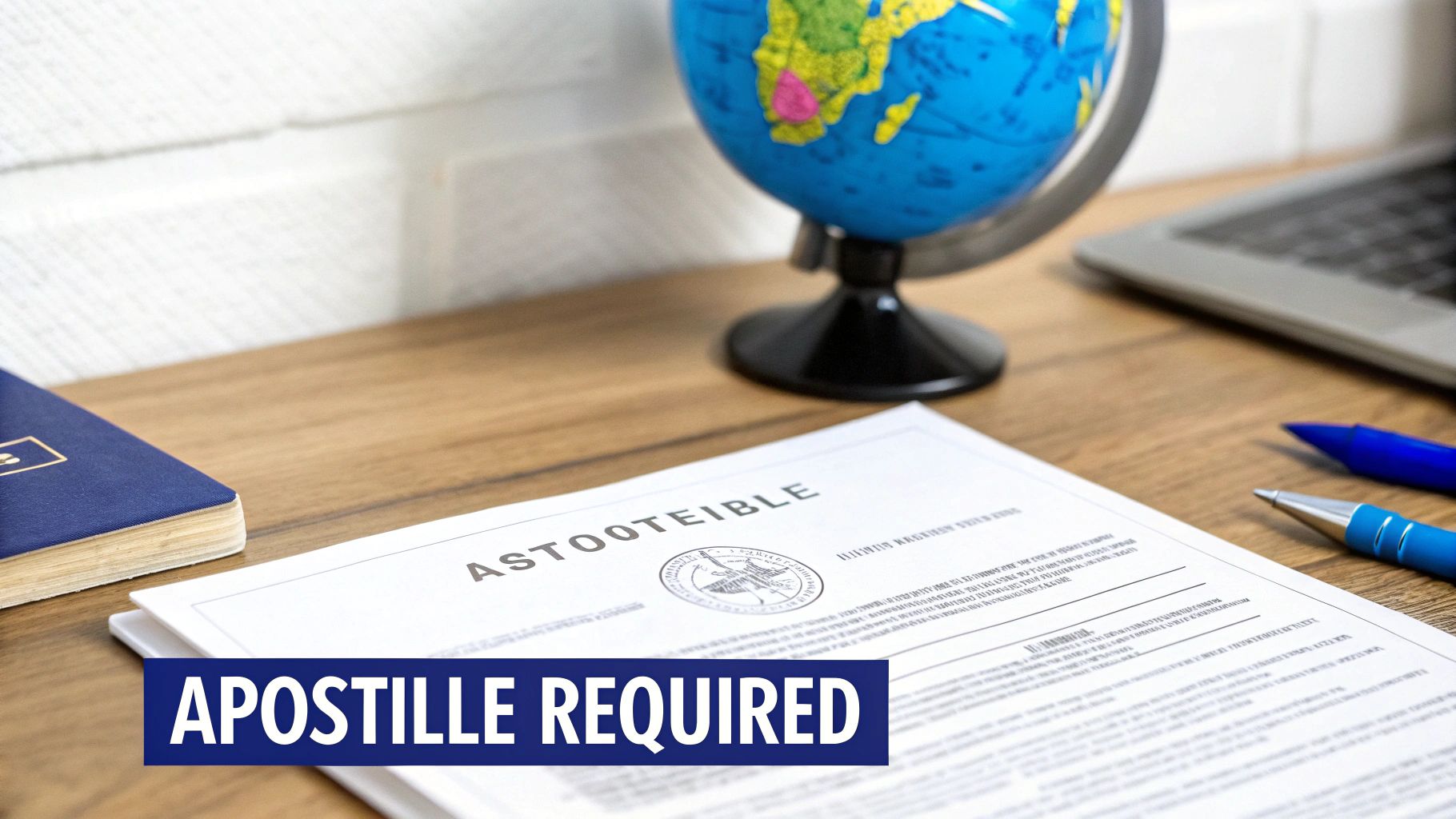
However, just having the certificate isn’t always enough. For it to be recognised abroad, it often needs an extra layer of official verification. This process is called legalisation, though you’ll more commonly hear it referred to as getting an apostille.
An apostille is a special stamp fixed to your document by the UK’s Foreign, Commonwealth & Development Office (FCDO). It authenticates the signature of the Companies House official, confirming to authorities in other countries that it’s a genuine, UK-issued document. This is a standard requirement for all countries signed up to the Hague Apostille Convention.
You will almost certainly need an apostilled certificate for activities like:
- Opening an overseas business bank account: Financial institutions need absolute certainty about your company’s legal standing before they’ll do business with you.
- Registering a foreign branch or subsidiary: It’s a foundational document when setting up a subsidiary, branch office, or liaison office in a foreign country.
- Entering into international contracts: It gives your partners confidence that your company is compliant and in good health.
If you’re a non-resident director, getting to grips with these international requirements from day one is vital. Our complete guide on UK company formation for non-residents offers more practical advice on navigating this. Factoring in the time for legalisation ensures your global plans aren’t derailed by preventable paperwork delays.
Your Questions Answered
When it comes to official documents like the Companies House certificate of good standing, it’s natural to have a few practical questions. Let’s tackle some of the most common ones we hear from business owners.
How Long Does It Take to Get a Certificate of Good Standing?
The waiting time really depends on which service you choose from Companies House. If you go with the standard option, you can typically expect the physical certificate to be dispatched within about four working days.
However, if you’re up against a tight deadline, there are usually express or even same-day services available for an extra fee. These faster routes can get a digital copy over to you much more quickly. It’s always a good idea to check the current processing times on the official website when you’re ready to order.
Can a Dormant Company Get a Certificate of Good Standing?
Absolutely. A dormant company can definitely get a Certificate of Good Standing. The most important thing is that the company is up-to-date with all its filing duties, even though it isn’t actively trading.
This just means its confirmation statement and any required dormant company accounts have been filed on time. The certificate is all about confirming your company’s legal compliance and good health on paper, not its day-to-day trading activity. For example, a company set up to hold a trademark might not trade, but as long as it files its dormant accounts and confirmation statement each year, it can obtain a certificate of good standing.
Is This Certificate the Same as a Certificate of Incorporation?
That’s a great question, and the answer is no – they are two completely different documents with very different jobs.
- A Certificate of Incorporation is your company’s “birth certificate.” It’s issued only once, right at the moment your company is legally formed, and it proves it exists.
- A Certificate of Good Standing is more like a “health check” or a snapshot in time. You can request one at any point to prove your company is currently meeting all its legal obligations.
You’ll only ever get one Certificate of Incorporation, but you might find yourself needing to order a Certificate of Good Standing many times over the years.
Keeping up with Companies House rules can feel like a full-time job, but you don’t have to manage it all on your own. Acorn Business Solutions provides a full range of compliance services, from setting up your company to filing your confirmation statements, making sure your business stays in perfect standing. Let us handle the admin, so you can get back to growing your business. https://acornbusinesssolutions.com
Related Topics

How to Write a Business Plan UK That Secures Funding
Learn how to write a business plan UK with our guide. Get actionable insights, real-world examples, and proven templates to turn your vision into reality.

8 Key Advantages of Being a Limited Company in the UK for 2026
Discover the top advantages of being a limited company. Our guide covers liability, tax efficiency, and credibility to help you decide if it’s right for you.
Professional Indemnity Insurance
Discover what is professional indemnity insurance, why your business needs it, and how it shields you from costly client claims.

What is a company secretary
Moving home? Learn how do you redirect your mail with Royal Mail or private services. A practical guide to costs, setup,

How Do You Redirect Your Mail in the UK?
Moving home? Learn how do you redirect your mail with Royal Mail or private services. A practical guide to costs, setup,

Top accounting courses for small business in the UK (2025)
Discover accounting courses for small business in the UK. Compare top options, pricing, and formats